
Facebook Ads Video Size: The Ultimate Guide for Marketers
Facebook Ads Video Size: The Ultimate Guide for Marketers (2026)
Creating a winning Facebook ad campaign involves more than just compelling storytelling and eye-catching visuals. In the crowded social media landscape, the technical foundation of your video ads can determine whether they captivate your audience or fall flat. As we move through 2026, getting your Facebook ad video size and specifications exactly right is non-negotiable. Uploading a video with the wrong dimensions can lead to awkward cropping, pixelation, or poor compression, wasting your ad spend and diminishing your brand’s credibility .
This ultimate guide provides marketers with the latest, most accurate Facebook video ad specs for 2026. We’ll break down the requirements for every major placement—from Feed to Reels—and share best practices to ensure your ads look stunning and perform optimally.
Why Video Ad Dimensions Matter More Than Ever
With over three billion users, Facebook (now part of Meta) remains a dominant force for advertisers . However, the platform is no longer a one-size-fits-all environment. Ads are served across a diverse ecosystem of placements, including Feed, Stories, Reels, Marketplace, and the Audience Network. Each placement has a unique viewing context, and using the correct specifications is crucial for several reasons:
Preserve Visual Integrity: Correct dimensions ensure your ad displays as intended—without being cropped, stretched, or distorted. This maintains the visual appeal and professional quality of your brand message .
Boost Engagement: A video that fills the screen correctly is more immersive. Misaligned ads can reduce visibility and negatively impact click-through rates (CTR) .
Optimize for the Algorithm: Facebook’s algorithm favors content that provides a good user experience. Videos that meet technical specs are more likely to be shown to your target audience .
Faster Load Times: Optimized video files load quicker, especially on mobile networks. This reduces viewer frustration and bounce rates, as users are less likely to wait for a large, bloated file to buffer .
Universal Facebook Video Ad Specifications for 2026
Before diving into placement-specific details, here are the universal technical requirements that apply to most Facebook video ads, as confirmed by multiple sources for 2026 :
Recommended File Types: MP4 or MOV. These offer the best balance of quality and compression .
Maximum File Size: 4GB .
Video Codec: H.264 compression is highly recommended for compatibility and quality .
Audio: Stereo AAC audio compression at 128kbps or higher .
Frame Rate: Use a fixed frame rate (around 30fps) .
Captions: While optional, adding captions is highly recommended, as many users watch videos with sound off. Facebook’s internal data shows captions can boost video view time by 12% .
2026 Facebook Video Ad Sizes by Placement
To help you navigate the different formats, here is a detailed breakdown of the specifications for each key Facebook ad placement.
Facebook Feed Video Ads
The Feed is where most ad impressions happen. For mobile optimization, a vertical format is your best bet as it takes up more screen space .
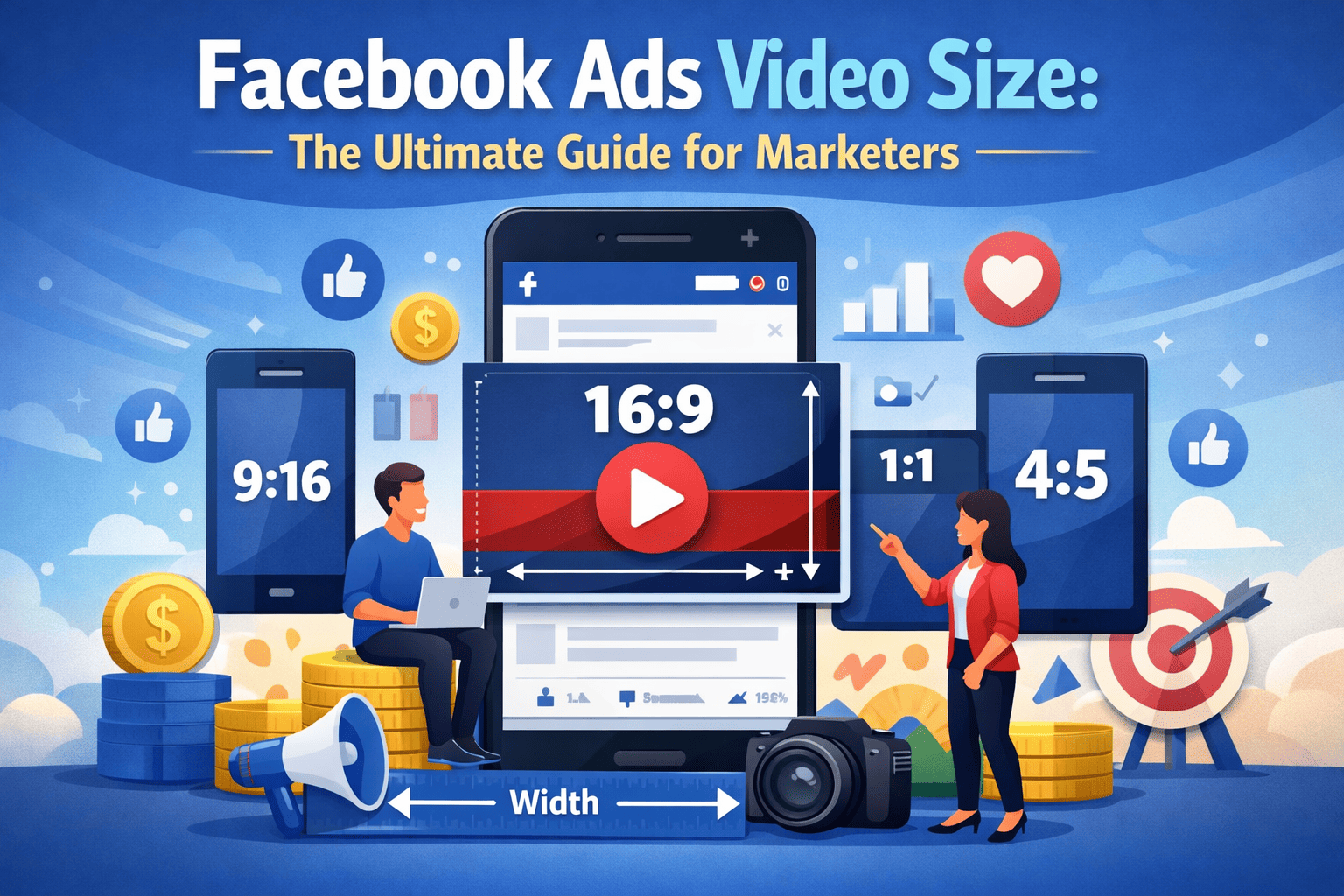
Aspect Ratio: 4:5 (recommended for mobile) or 1:1 (square for desktop/mobile). While 16:9 and 9:16 are supported, they may be masked to fit .
Recommended Resolution: 1080 x 1350 pixels (for 4:5) or 1080 x 1080 pixels (for 1:1) .
Video Length: Up to 241 minutes. However, for advertising, shorter is often better. A length of 10-15 seconds is considered ideal for capturing attention .
Facebook Reels Video Ads
Reels are designed for immersive, full-screen, mobile-first viewing and favor audio-forward content .
Aspect Ratio: 9:16 .
Recommended Resolution: 1080 x 1920 pixels .
Video Length: Up to 90 seconds .
Key Difference: Unlike Feed ads, silent Reels rarely perform as well as those using original audio or trending sounds .
Facebook Stories Video Ads
Stories are another full-screen, vertical format that appears between user stories. They are ephemeral and require immediate attention-grabbing content.
Aspect Ratio: 9:16 .
Recommended Resolution: 1080 x 1920 pixels .
Video Length: Up to 2 minutes, but videos longer than 15 seconds will be split into multiple cards. A strong hook in the first 1-3 seconds is critical, as users can quickly swipe away .
Safe Zones: This is crucial for Stories. Keep important content (like text and logos) clear of interface elements.
Top: Leave approximately 250 pixels clear from the top to avoid the profile icon and status bar .
Bottom: Leave approximately 340 pixels clear from the bottom to avoid the “Send Message” button and CTA .
Facebook Carousel Video Ads
Carousel ads allow users to swipe through multiple videos or images in a single ad unit, perfect for showcasing multiple products or telling a sequential story.
Aspect Ratio: 1:1 (square) is recommended for consistency .
Recommended Resolution: 1080 x 1080 pixels .
Video Length: Up to 240 minutes per card. Shorter clips (under 15 seconds) typically perform better in this format .
Card Limits: 2 to 10 cards. All cards in a carousel should use the same aspect ratio .
Facebook In-Stream Video Ads
These are the short ads that play before, during, or after other video content, such as Facebook Live streams or Reels.
Aspect Ratio: 16:9 (landscape) or 1:1 (square) .
Recommended Resolution: At least 1280 x 720 pixels for 16:9 .
Video Length: 5 to 15 seconds for desktop; up to 10 minutes for mobile, though shorter is strongly recommended to avoid viewer irritation .
Facebook Marketplace & Right-Column Video Ads
Marketplace: This placement is for users actively shopping. Use a square format for the best look in the browse-and-scroll layout .
Aspect Ratio: 1:1 .
Resolution: 1080 x 1080 pixels minimum .
Right-Column: This is a desktop-only placement with smaller dimensions.
Aspect Ratio: 1:1 .
Minimum Size: 254 x 133 pixels, though uploading a higher resolution (e.g., 1080 x 1080) ensures sharper quality .
Here’s a quick reference table summarizing the most common placements:
| Placement | Recommended Aspect Ratio | Recommended Resolution | Max. Video Length |
|---|---|---|---|
| Feed (Mobile-First) | 4:5 | 1080 x 1350 px | 241 min |
| Feed (Square) | 1:1 | 1080 x 1080 px | 241 min |
| Reels | 9:16 | 1080 x 1920 px | 90 sec |
| Stories | 9:16 | 1080 x 1920 px | 2 min* |
| Carousel | 1:1 | 1080 x 1080 px | 240 min per card |
| In-Stream | 16:9 or 1:1 | 1280 x 720 px (min) | 5-15 sec (ideal) |
| Marketplace | 1:1 | 1080 x 1080 px | 240 min |
**Stories longer than 15 seconds are split into multiple cards.*
Best Practices for High-Performing Facebook Video Ads
Knowing the dimensions is just the first step. To truly maximize your ROI, follow these expert best practices:
Design for Mobile First: The vast majority of Facebook ad impressions occur on mobile devices. Use larger text, clear CTAs, and simple compositions that are easy to understand on a small screen .
Prioritize the First Few Seconds: You have a mere second or two to stop a scroller. Place your most compelling visual or hook right at the beginning of your video .
Don’t Rely on Sound: Since videos autoplay on mute, use captions and on-screen text to convey your message. This ensures your ad is effective regardless of whether a user has sound on .
Respect Safe Zones: For full-screen placements like Stories and Reels, always keep your essential text, logos, and CTAs within the “safe zones” to prevent them from being covered by Meta’s interface buttons .
A/B Test Your Creatives: Don’t just set and forget. Run A/B tests with different video lengths, aspect ratios (e.g., 1:1 vs. 4:5), and hooks to see what resonates best with your specific audience

Common Mistakes and How to Fix Them
Even with the best intentions, errors can happen. Here’s how to troubleshoot the most common issues:
Problem: Blurry or Pixelated Video.
Solution: You likely uploaded a video below the recommended resolution. Always design at or above the recommended pixel dimensions (e.g., 1080p), not the minimum requirements .
Problem: Important Content is Cropped Out.
Solution: You’re not accounting for safe zones or placement-specific cropping. Re-edit your video to ensure all critical elements fit within the center of the frame, especially for Stories and Reels .
Problem: Video Upload Fails.
Solution: This is usually due to an excessive file size (over 4GB), an unsupported codec, or an incorrect file format. Compress your video and ensure it’s saved as an MP4 with H.264 codec .
Problem: Inconsistent Display Across Placements.
Solution: If you use a single 16:9 video for all placements, it will look terrible in a vertical Story slot. Instead of a one-size-fits-all approach, create placement-specific variants or use a tool that helps you resize your assets correctly .
FAQs
Facebook allows videos up to 240 minutes in length, but for ads, shorter videos are more effective. A video ad should ideally be between 15 and 60 seconds long.
Facebook supports a range of aspect ratios for video ads, including 16:9, 9:16, and 1:1. However, 1:1 (square) and 16:9 (landscape) are the most commonly used aspect ratios for Facebook video ads.
Facebook supports a range of video file formats, including MP4, MOV, and GIF. However, MP4 is the most commonly used and recommended format for Facebook video ads.
While Facebook supports sound in video ads, it is important to remember that many users watch videos on their mobile devices without sound. It is therefore important to ensure that your video ad works without sound and includes captions or text overlays.
Conclusion
Mastering the technical specifications for Facebook video ads is a fundamental part of modern social media marketing. By using the correct 2026 Facebook ad video sizes, resolutions, and formats outlined in this guide, you ensure your creative ideas are executed flawlessly. Properly optimized videos look professional, load quickly, and provide a seamless viewing experience that keeps your audience engaged.
In a platform with over 3 billion users, these details can be the difference between an ad that converts and one that is simply scrolled past . Use this guide as your checklist, and you’ll be well on your way to launching campaigns that are not only visually stunning but also primed for high performance.